Checking Accounts for Small Business Reviews
We started with a list of 15 business checking accounts and evaluated them based on five essential features for small businesses: Online & Mobile Banking, Business Banking Services, Competitive Interest Rates, FDIC or NCUA Insurance, and Customer Experience. We also considered fees, transaction limits, account perks, and how each account helps small businesses manage day-to-day finances efficiently.

Grasshopper Bank – Best for Cashback & Business Growth
Grasshopper Bank positions itself as a small business‑friendly bank that scales with your company; it focuses on digital tools and offers incentives like unlimited 1% cash back on debit card purchases, and competitive APYs on checking balances. If your business is online‑first, growth‑oriented, and values perks like cashback and no monthly maintenance fees, Grasshopper is worth considering.
- No monthly maintenance fee
- Unlimited transactions
- 1% cashback on purchases
- Digital banking tools
- $100 minimum opening deposit
- No physical branches
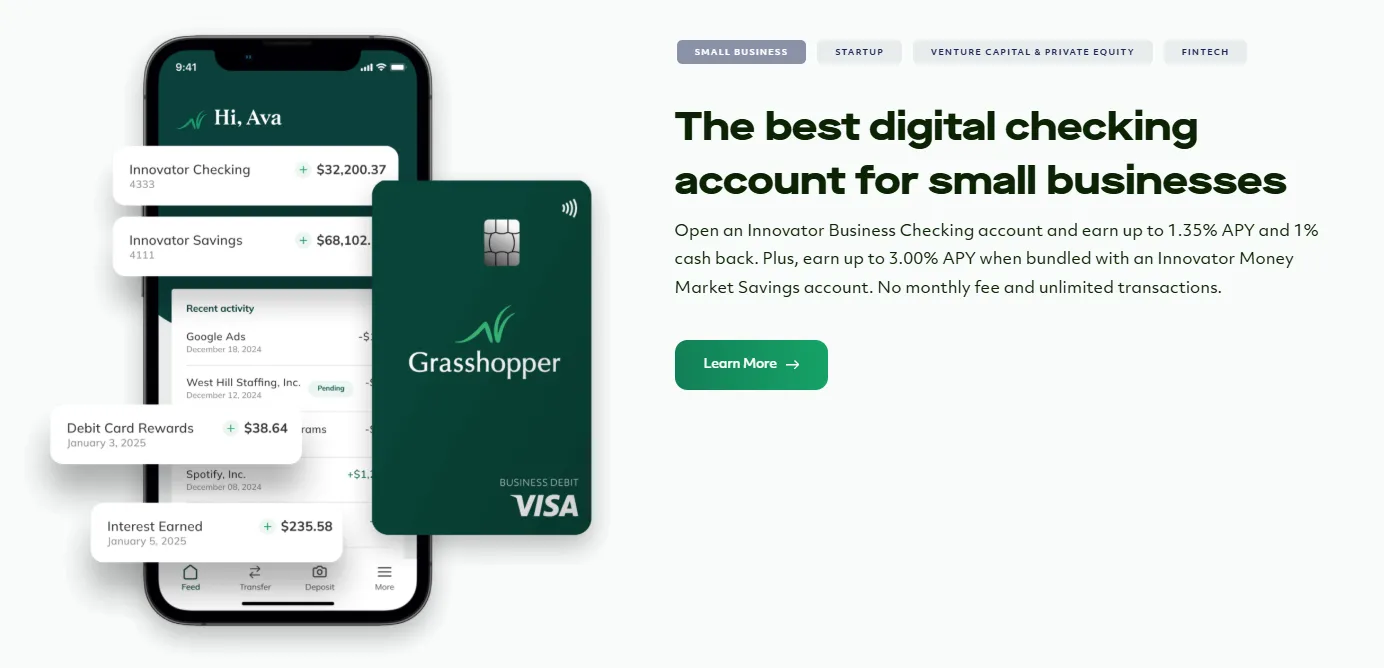
Grasshopper Bank small business. Source: Grasshopper.bank
Get Started Visit Grasshopper Bank’s website
Grasshopper Bank features
- Online & Mobile Banking: Full digital platform with mobile deposit, virtual cards, accounting integrations, and unlimited transactions
- Business Banking Services: Unlimited transactions, free ACH, incoming wires, Visa debit card with 1% spending rewards
- Competitive Interest Rates: Up to ~1.55% APY on the checking account; paired savings yield even higher
- FDIC or NCUA Insurance: FDIC‑insured
- Customer Experience: Digital onboarding in minutes, no monthly fee, modern fintech style support
How Grasshopper Bank pricing works
Grasshopper Bank has no monthly fees and unlimited transactions. The initial business deposit for opening an account is $100 with interest and cashback rewards structured by balance tiers.
What markets does Grasshopper Bank serve?
Grasshopper Bank serves startups, digital businesses, and small‑to‑medium growth companies that value tech‑friendly features and rewards over branch access.
Read our full Grasshopper Bank review
Piermont Bank – Best for Flexible Transaction-Based Businesses
Piermont Bank offers business checking with a flexible transaction‑based fee model that suits companies with moderate volumes but variable activity. It pairs checking with high‑yield business savings/money-market accounts. Additionally, multi-million-dollar FDIC insurance coverage is available. If your transaction profile varies and you want flexibility, Piermont is a contender.
- First ~25 transactions free
- High-yield savings options
- SMB-focused digital tools
- Secured FDIC-insured accounts
- Transaction fees for high volumes
- Limited branch network
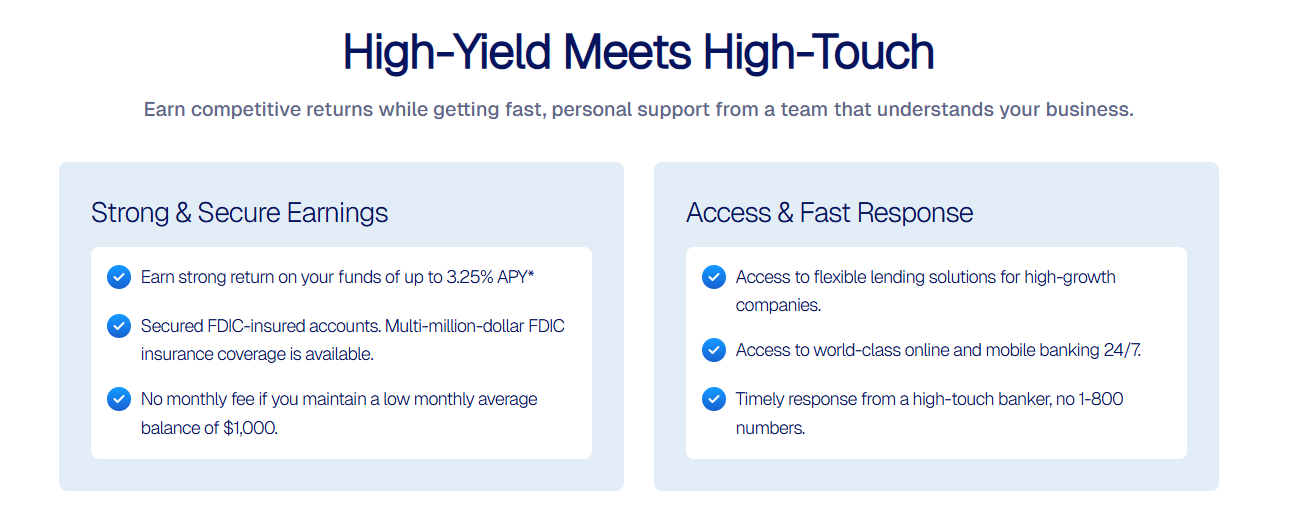
Piermont Bank small business. Source: Piermontbank.com
Get Started Visit Piermont Bank’s website
Piermont Bank features
- Online & Mobile Banking: Digital account opening, mobile banking interface and business tools
- Business Banking Services: Business checking with defined free-transaction allowance then per-transaction fees; cash-management and savings combo available
- Competitive Interest Rates: Particularly strong on savings/money market side; checking modest
- FDIC or NCUA Insurance: FDIC insured
- Customer Experience: Focused on SMBs, flexible structure, transparent transaction pricing
How Piermont Bank pricing works
Piermont Banks’ business checking allows for the first 25 transactions to be free; subsequent transactions are charged per schedule depending on the account type.
What markets does Piermont Bank serve?
Piermont Bank serves small to mid‑sized businesses as well as larger and scaling SMBs. It functions best for businesses with moderate to variable transaction volume and those that want flexible checking while pairing with high‑yield savings for idle balances. Contact Piermont Bank today to open your account in just 10 minutes.
Read our full Piermont Bank review

Slash – Best Free Banking for Digital-First Entrepreneurs
Slash Financial, a fintech company, offers a free business checking account. The checking account is designed for digital-first businesses and entrepreneurs, offering zero monthly fees, no minimum balance requirements, and FDIC insurance for up to millions of dollars. Slash offers business banking tools, yield options for idle cash, virtual and physical cards, and free domestic wire and ACH transfers (no per-transaction fees). International wires are available at a small fee.
Slash business banking tools are built to scale, meaning it can support sole proprietors as well as LLCs and corporations. Enjoy physical debit and unlimited virtual cards, each of which can be assigned to vendors, campaigns, or team members, all with individual spend controls. With Slash, you can manage all transactions from one dashboard, get real-time spending insights & financial trends, and earn a 3.82% annualized yield on idle cash in your checking account.
- Cashback on all purchases
- High-yield on every deposit
- SOC2 Type II and PCI compliant
- Slight learning curve
- Reporting features are limited

Slash marketing analytics. Source: Slash website.
Slash features
- Online & Mobile Banking: Access your checking account online and on your mobile device to easily deposit checks, move money, and track everything in real time. (Mobile app is currently limited to IOS.)
- Business Banking Services: Enables small businesses to send free wires, automate tasks, create unlimited virtual cards, and ensure up to millions of dollars, all with no monthly fee or minimum deposits.
- Competitive Interest Rates: The Slash Treasury provides a yield of up to 3.82% without surprise fees, and the Slash Savings provides a competitive yield of up to 1.89% APY.
- FDIC or NCUA Insurance: FDIC insured up to millions of dollars.
- Customer Experience: Customers praise Slash for its intuitive platform, responsive support, and industry-specific tools.
How Slash pricing works
Slash offers free business checking accounts with no monthly fees, no hidden charges, and no minimums for the entire life of your account. Slash offers two pricing plans:
- Free: Starts at $0/month (all features available, but some are an additional cost)
- Pro: Starts at $25/month (all features available)
Certain features, like wires and ACH transfers, have a small fee on the free plan but are included on the Pro plan. However, outgoing international wires cost $25 on both plans. There is also an instant deposit fee of 0.2% (max $50) on both plans. Foreign transactions on corporate cards also incur a 1% fee (min $0.4). Physical cards are an additional $5 on both plans.
What markets does Slash serve?
Slash focuses on providing tailored checking account services for specific niches. It supports specialized markets such as e-commerce & retail, performance marketing, web3 & crypto, healthcare, global importers, and more.
Read our full Slash review

First Internet Bank – Best for Low Fees
First Internet Bank is a digitally‐native, branchless bank that has focused on small business owners by offering its Do More Business™ Checking account. It’s built around entrepreneurship: you’ll find unlimited transactions, interest‑earning potential, and tools like cash‑flow analysis and Zelle integration. For business owners who want a streamlined, mostly online banking experience without the burden of high monthly fees or minimum balances, First Internet Bank delivers.
- No monthly service fee
- No minimum daily balance
- Unlimited transactions
- Digital cash flow tools
- Fully online, no branches
- Modest interest rates
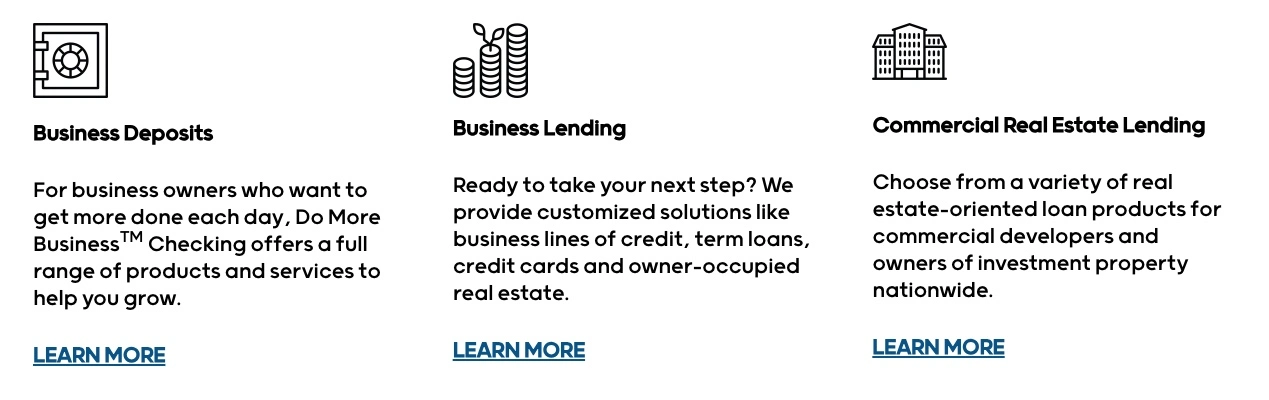
First Internet Bank business banking. Source: Firstib.com
First Internet Bank features
- Online & Mobile Banking: Robust business app including mobile deposit, transfers, alerts, user permissions, and integrations
- Business Banking Services: Unlimited transactions and withdrawals, multi‑user access, and digital tools aimed at small businesses
- Competitive Interest Rates: Offers interest on account balances via the checking account
- FDIC or NCUA Insurance: FDIC‑insured
- Customer Experience: Digital onboarding, dedicated customer success team for business account holders
How First Internet Bank pricing works
First Internet Bank has no monthly maintenance fee, no minimum balance, and unlimited transactions. Some specific services (like wires) may carry separate fees.
What markets does First Internet Bank serve?
First Interest Bank serves small businesses that prefer fully online banking, high transaction volumes, minimal fees, and don’t require physical branch access.

Live Oak Bank – Best for High Balance Businesses
Live Oak Bank is an online bank that emphasizes business banking for companies comfortable with digital‑only services, and that may maintain higher balances or require more advanced services like sweep programs and extended FDIC coverage. If your business holds significant deposits and deposit accounts or you want a more tailored business banking relationship, Live Oak stands out.
- Fee waivers with reasonable balances
- High FDIC coverage via sweep program
- Tiered business checking
- No physical branches
- Fees may apply for some tiers
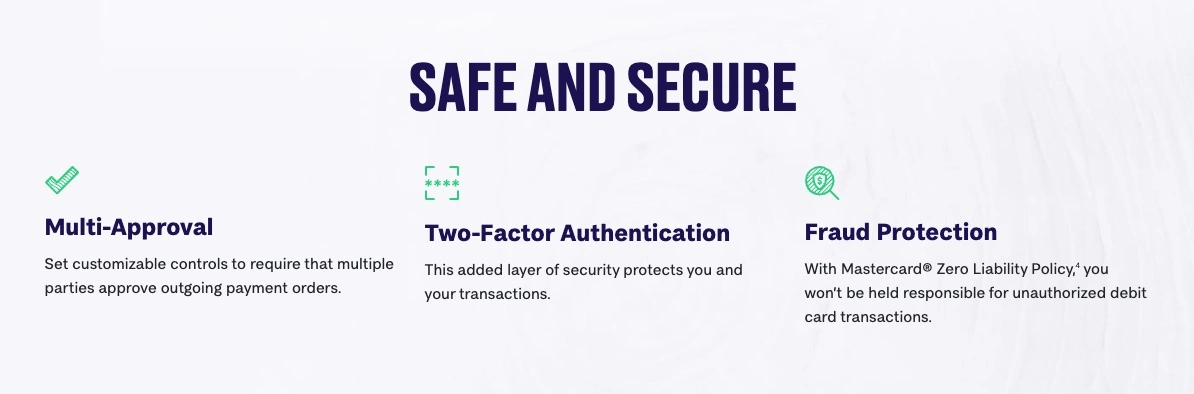
Live Oak Bank small business. Source: Liveoak.bank
Live Oak Bank features
- Online & Mobile Banking: Digital business checking accounts, mobile deposits, online transfers, but no branch footprint
- Business Banking Services: Three tiers of business checking (Essential, Plus, Plus Analysis) including tools like ACH, wire transfers, multi‑company views
- Competitive Interest Rates: Checking interest modest; associated business savings accounts earn strong yields and sweep program extends FDIC coverage
- FDIC or NCUA Insurance: FDIC insured; also offers extended coverage via sweep program for large deposits
- Customer Experience: U.S.-based phone support, streamlined onboarding, clear digital focus
How Live Oak Bank pricing works
Live Oak Bank offers three pricing tiers for their business checking accounts:
- Business Essential: Starting at $10/month; waivable with $1,000 average daily balance
- Business Plus: Starting at $25/month; waivable with $25,000 average daily balance
- Business Plus Analysis: Starting at $100/month; earnings credit can offset fees
What markets does Live Oak Bank serve?
Live Oak Bank serves small to mid‑sized businesses and service firms that hold moderate to high balances and prefer a fully digital banking partner rather than in‑person branch access.
Digital Federal Credit Union – Best for Fee-Conscious Businesses
Digital Federal Credit Union (DCU) is a nonprofit credit union that offers business checking with minimal fees and a simple structure, making it suitable for small businesses looking for basic checking without hefty costs. While interest is modest, the straightforward fee structure is the draw.
- Free business checking
- Low fees
- Member-focused
- Membership eligibility
- Limited technical support
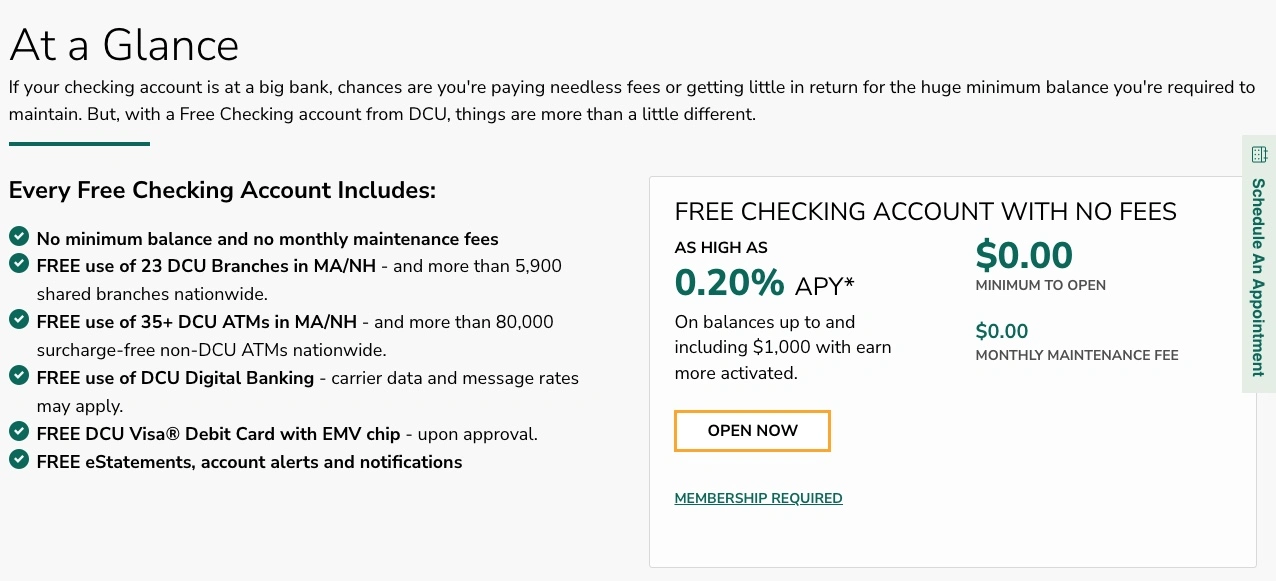
Digital Federal Credit Union checking account. Source: dcu.org
Digital Federal Credit Union features
- Online & Mobile Banking: Offers business checking online/mobile access via a credit union platform
- Business Banking Services: Basic business checking, business savings, limited frills but low cost
- Competitive Interest Rates: Very modest interest on checking
- FDIC or NCUA Insurance: NCUA-insured credit union
- Customer Experience: Mixed reviews, member-centric philosophy
How Digital Federal Credit Union pricing works
There is no monthly maintenance fee and no minimum balance; their focus is on keeping costs down rather than maximizing yield.
What markets does Digital Federal Credit Union serve?
DCU serves small businesses and sole proprietors seeking simple, low-cost checking, especially if they qualify for membership in the credit union.
Service Federal Credit Union – Best for Member-Focused Business Banking
Service Federal Credit Union offers business checking aimed at delivering value for members with no monthly fees on the base account and an optional tiered dividend-earning account for higher balances. They emphasize member ownership, strong service, and digital access.
- Free base checking
- Dividend-earning tier
- Member-focused support
- Branch access may vary
- Modest dividend rates
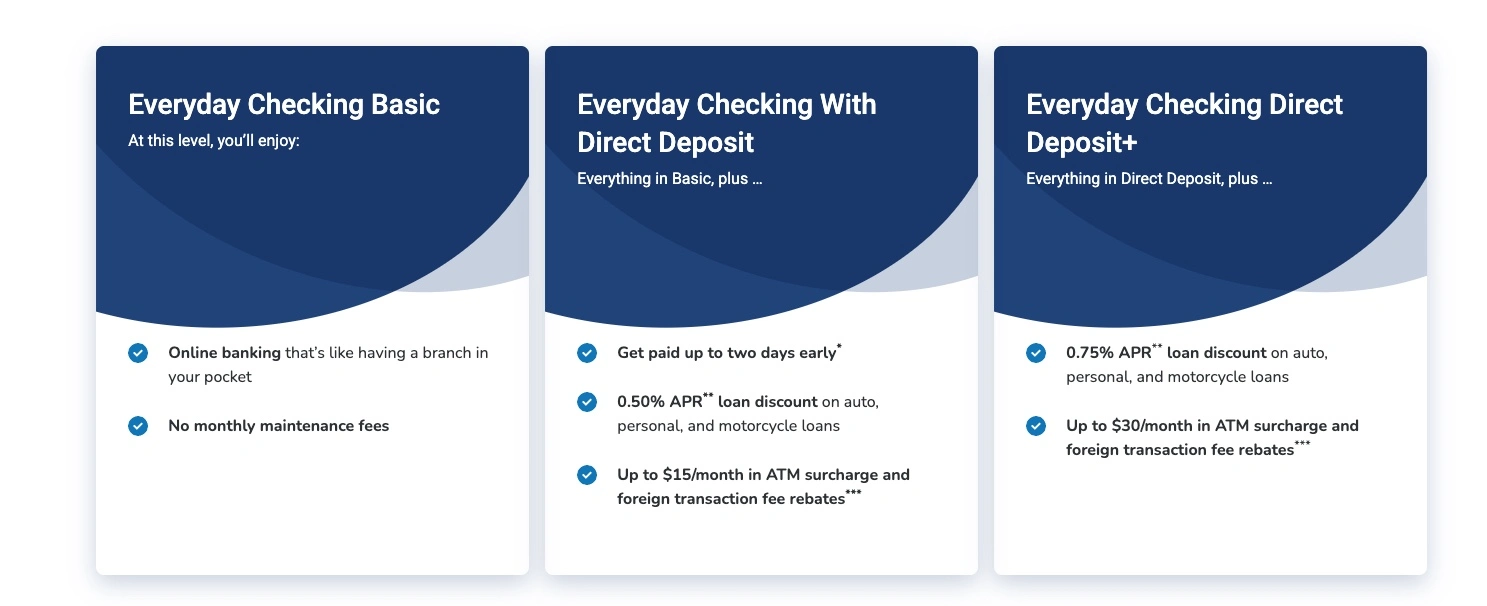
Service Federal Credit Union checking. Source: Servicecu.org
Service Federal Credit Union features
- Online & Mobile Banking: Full business banking via mobile app/web, including invoicing and integrations
- Business Banking Services: Unlimited check deposits and writing, business debit cards, business savings and equipment financing
- Competitive Interest Rates: Modest for base checking; higher for BusinessPlus tier
- FDIC or NCUA Insurance: NCUA-insured
- Customer Experience: Member-centric philosophy, credit-union values, good support for business members
How Service Federal Credit Union pricing works
For Service Federal Credit Union’s base business checking, there is no monthly fee and no minimums. Its dividend-earning tier requires maintaining higher balances but returns a modest yield.
What markets does Service Federal Credit Union serve?
Service Federal Credit Union serves small to growing businesses looking for a low-cost checking account with good service, especially for those comfortable with online banking and credit-union membership.
Compare the Best Checking Accounts for Small Business Side-by-Side
| Software name | Why we picked it | Starting price for cheapest plan | Highlights |
|---|---|---|---|
| Grasshopper Bank | Best for Cashback & Business Growth | $0 (with $100 opening deposit) | 1% debit cashback, fintech integrations |
| Piermont Bank | Best for Flexible Transaction-Based Businesses | $0 (first 25 transactions free) | SMB-focused, high-yield savings |
| Slash | Best Free Banking for Digital-First Entrepreneurs | $0 | No monthly fees or minimum deposits |
| First Internet Bank | Best for Low Fees | $0 | Fully digital, cash flow tools |
| Live Oak Bank | Best for High Balance Businesses | $10/month | Sweep program, tiered checking |
| Digital Federal Credit Union | Best for Fee-Conscious Businesses | $0 | Free checking, member-centric |
| Service Federal Credit Union | Best for Member-Focused Business Banking | $0 | Dividend tier available, supportive service |
What is a Checking Account for Small Businesses?
A small business checking account is a bank or credit union account specifically designed to manage business income, expenses, and payroll. Unlike personal checking, these accounts handle higher transaction volumes, allow multiple users, integrate with accounting software, and sometimes earn interest. They’re essential for separating business finances from personal funds, simplifying taxes, and keeping a clear financial record, which is why 96% of all small firms maintain a business bank account.
How Do I Open a Business Checking Account?
Choosing a bank or credit union that meets your company’s requirements, such as online enrollment and access, transaction limits, or a fee structure, is the first step in opening a business checking account.
Gather the necessary paperwork, which usually consists of your Social Security number or Employer Identification Number (EIN), ownership agreements, business formation documents (such as LLC or Articles of Incorporation paperwork), and personal identification for each authorized signer.
Next, apply online or in person, fund the account with the required minimum deposit, and set up any other services, such as bill pay processing (typically processes within 1-3 business days), debit cards, or online banking. Your account is prepared for business transactions after it has been approved.
What Are the Best Loan Options for Small Businesses?
The best loan options for small businesses depend on your funding needs, credit profile, and repayment timeline. Common options include SBA loans, which offer low interest rates and long terms; business lines of credit, providing flexible access to funds as needed; term loans for lump-sum financing with fixed repayment schedules; equipment financing for purchasing machinery or technology; and business credit cards for short-term expenses.
Evaluating interest rates, fees, eligibility requirements, and repayment terms can help you choose the business loan type that best supports your growth and cash flow needs.
How Much Do Checking Accounts for Small Businesses Cost?
Business checking accounts may have:
- No monthly fees: Often with digital-only banks
- Tiered fees: Based on balance requirements
- Transaction fees: Some charge after a number of free transactions
- Special services: Wires, cash deposits, and equipment financing may carry additional fees
Checking Accounts for Small Business FAQs
Which is the best bank for a small business account?
The “best” bank for a small business depends on your business needs—but among our picks, if you want no‑monthly‑fee checking with unlimited transactions and solid digital tools, First Internet Bank stands out. If you’re a startup or online‑first business that values cash‑back and fintech integrations, Grasshopper Bank is excellent. For higher balances and tiered services, Live Oak Bank fits well.
If your transaction volume varies and you want flexibility, Piermont Bank offers a transaction‑based model. For qualifying cost‑conscious businesses for membership, Digital Federal Credit Union (DCU) provides free business checking. And if you prefer a member‑focused approach via a credit union with optional dividend‑earning tiers, Service Federal Credit Union is a strong choice.
What features should I look for in a checking account for my small business?
When choosing a checking account for your small business, look for features that support your everyday operations and future growth—these include:
- Strong online & mobile banking with mobile deposits, transfers, alerts, and a user‑friendly app.
- Robust business banking services such as ACH and wire transfers, multiple user access, integration with accounting software, and merchant services with payment compatibility.
- Low fees and transparent costs, including minimal or no monthly maintenance fees, few transaction fees, and realistic minimum balance requirements.
- Deposit insurance and security, making sure the bank or credit union offers FDIC (for banks) or NCUA (for credit unions) coverage and strong fraud and overdraft protection tools.
- Scalability and a good customer experience, meaning the account should accommodate your business as it grows and the bank should offer responsive support.
Together, these features help ensure the checking account not only meets your current needs but also lays a foundation for smooth financial management as your business expands.
What do I need to open a business bank account?
Important documents proving the legal and financial identity of your company are required to open a business bank account. These include your Employer Identification Number (EIN) or Social Security Number, business formation documents like articles of incorporation, LLC paperwork, or partnership agreements, and the personal identification of all authorized signers. Additionally, some banks for small businesses might ask for an operating agreement or business license. Whether you open the account in person or online, having these documents on hand guarantees a seamless application process.
Can you use a personal bank account for your small business?
Although it’s not advised, it is technically possible to use a personal bank account for your small business. Combining personal and business finances can lead to accounting issues, make tax returns more difficult, and possibly make your personal assets liable. Keeping your finances organized and understanding your financial institution’s statement cycle, tracking income and expenses, and establishing credibility with lenders, vendors, and customers are all made easier with a dedicated business checking account. It is safer and more professional for the majority of small businesses to keep personal and business accounts separate.
How We Chose the Best Checking Accounts for Small Business
We compiled a list of 15 small business checking accounts and narrowed it down to six top picks based on robust features, low fees, and ease of use. Each account was evaluated across five key areas: Online & Mobile Banking, Business Banking Services, Competitive Interest Rates, Member FDIC or NCUA Insurance, and Customer Experience.
We collected and verified information from multiple sources, including:
- Customer reviews and testimonials
- Bank and credit union websites
- Product feature documentation
- Expert analyses from finance and small business publications
Each small business checking account was scored on a scale of 1 (poor) to 5 (excellent) across the following criteria:
- Variety of features: We assessed each account’s ability to handle transactions, offer multiple user access, integrate with accounting software, and provide digital tools for managing finances. Accounts with flexible transaction limits, mobile access, and robust payment capabilities scored highest.
- Pricing and transparency: We compared monthly fees, transaction fees, minimum balance requirements, and clarity of pricing information. Banks with clear, scalable, and low-cost options earned higher marks.
- Onboarding and support: We evaluated the account setup process, availability of online or in-branch support, and responsiveness of customer service. Accounts with straightforward onboarding and multiple support channels ranked higher.
- Brand reputation: We considered overall reliability, customer satisfaction, and the track record of serving small businesses. Well-established banks and credit unions with strong reputations scored best.