Recruiting Software Reviews
To identify the best recruiting software, we evaluated each platform using five major metrics: platform foundation and customization, sourcing and candidate identification, applicant tracking and candidate management, recruiting workflow, and reporting and analytics.

RemotePeople – Best for Global Hiring
RemotePeople takes a different approach than the other platforms on this list: rather than a self-serve ATS you configure yourself, it’s an Employer of Record (EOR) and global payroll company that bundles in-house recruitment into its service. RemotePeople handles sourcing and recruitment through its own team, then supports the full employment lifecycle with localized contracts, international payroll, benefits administration, and compliance across 150+ countries. This makes it a fit for companies that want to hire internationally without setting up legal entities in each country, rather than for teams that want a configurable recruiting platform.
- Combines recruitment, compliant employment, and payroll through a single provider
- Fast onboarding across 150+ countries with locally drafted employment contracts
- Transparent, predictable per-employee pricing with no hidden fees
- Limited third-party software integrations compared with dedicated ATS platforms
- Recruitment is delivered as a managed service rather than self-serve sourcing or ATS software
- Not a fit for teams that specifically want candidate pipeline, career page, or interview scheduling tools
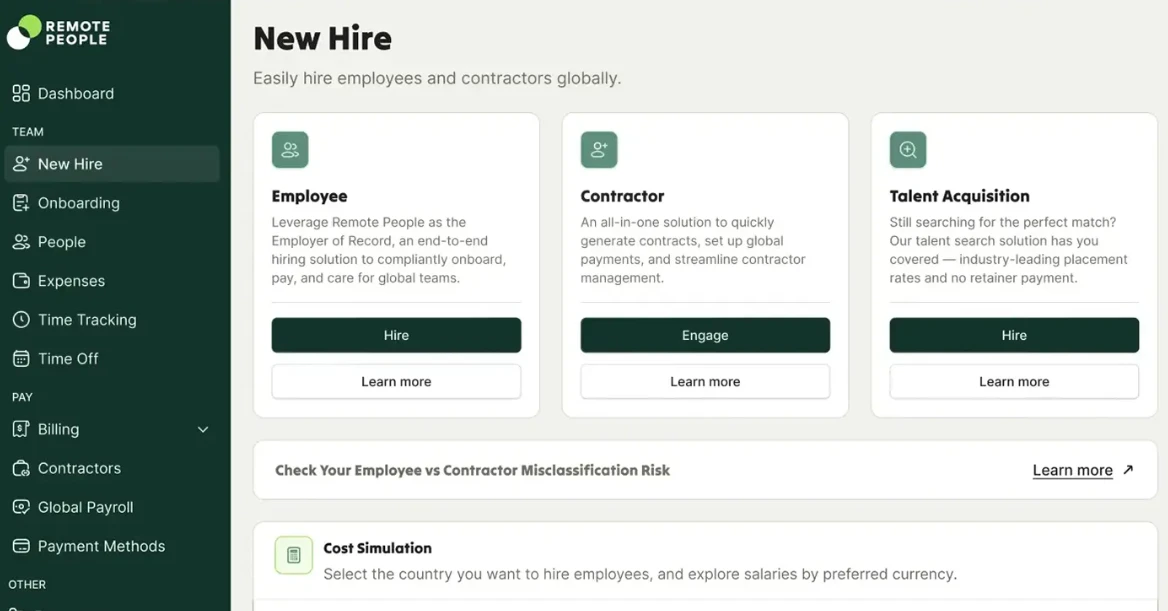
RemotePeople new hire page.
Book a Demo Visit RemotePeople’s website
RemotePeople features
- Platform Foundation & Customization: Not offered as configurable software — recruitment is delivered as an in-house service by RemotePeople’s own team rather than through a self-serve, API-driven platform.
- Sourcing & Candidate Identification: Sourcing happens, but RemotePeople’s recruiters do it for the client rather than through client-facing search or AI recruiting tools.
- Applicant Tracking & Candidate Management: Not offered — there’s no ATS, candidate evaluation, or resume-parsing functionality for clients to use themselves.
- Recruiting Workflow: Limited to the employment side — locally drafted contracts, digital signatures, and visa/work-permit support — rather than interview scheduling or hiring-pipeline tools.
- Reporting & Analytics: Limited to a payroll/compliance dashboard covering salaries, taxes, and costs; no recruiting-specific reporting or analytics.
How RemotePeople pricing works
RemotePeople uses transparent, per-employee pricing rather than published per-seat software tiers; exact rates depend on the country of hire and are provided through a custom quote.
- Recruit + EOR: 2% of annual salary (spread over 12 months)
- Global Recruitment: 20% of annual salary (paid on candidate’s first day)
- Executive Search: 25% of annual salary (paid on candidate’s first day)
What markets does RemotePeople serve?
RemotePeople is best suited for companies that want to hire and employ international talent without opening a local entity, especially startups and scaling businesses new to global hiring.
Read our full RemotePeople review

Workable – Best for Small and Mid-Sized Teams
Workable is a full-lifecycle hiring platform that covers everything from job posting to onboarding. The platform lets recruiters post open roles to more than 200 job boards at once, source candidates from a database of over 400 million profiles, and build branded career pages to attract applicants directly. In 2026, Workable leans heavily on AI, offering AI-assisted resume screening, candidate recommendations, automated resume parsing, salary suggestions, job description generation, and AI-drafted interview kits. Beyond the ATS, Workable also includes lightweight HRIS features like employee profiles, org charts, time tracking, and onboarding workflows, making it a reasonable fit for teams that want hiring and early employee performance management in one system.
- Comprehensive, full-lifecycle hiring workflow automation
- Strong AI-assisted sourcing and screening tools
- One-click posting to 200+ job boards and a large candidate database
- Reporting and analytics are considered fairly basic, with limited customization
- Pricing climbs quickly as employee headcount grows
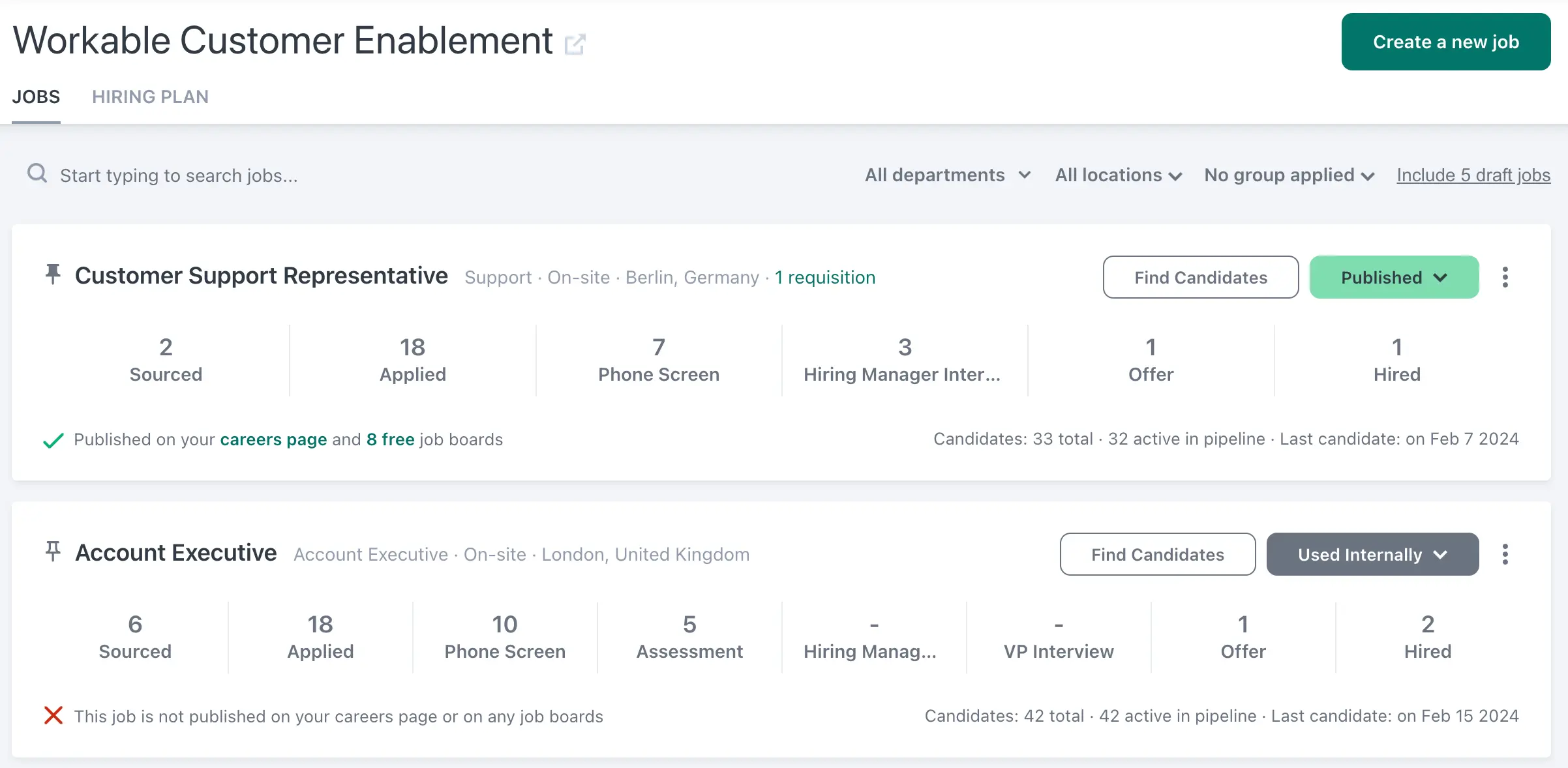
Workable customer enablement.
Workable features
- Platform Foundation & Customization: 270+ integrations, a branded and customizable careers page, and lightweight HRIS features like employee profiles and org charts give teams a flexible base to build hiring workflows on.
- Sourcing & Candidate Identification: Search a database of 400M+ profiles, tap AI-powered candidate recommendations, and distribute job posts to 200+ boards with one click.
- Applicant Tracking & Candidate Management: Structured pipelines, scorecards, AI-assisted resume screening, and automated resume parsing keep candidates organized from application through offer.
- Recruiting Workflow: Self-scheduling interview links, AI-drafted interview kits, and collaborative hiring-team feedback tools move candidates through each stage.
- Reporting & Analytics: Built-in reporting tracks hiring metrics, though users describe it as fairly basic with limited customization options.
How Workable pricing works
Workable’s pricing scales with total employee headcount rather than the number of recruiters using the platform, and plans are offered on monthly or annual billing with a 15-day free trial available.
- Standard: Starting at $360/month
- Premier: Starting at $599/month
- Enterprise: Starting at $719/month
What markets does Workable serve?
Workable works well for small and mid-sized businesses as well as larger enterprises across industries like technology, healthcare, financial services, and retail that want structured, collaborative hiring without a heavy implementation lift.
SeekOut – Best for AI-Powered Candidate Sourcing
SeekOut is a talent intelligence and sourcing platform built for teams that need to find hard-to-reach candidates, particularly in technical and specialized fields. The platform combines AI-driven search with a large database of candidate profiles, letting recruiters filter by skills, work history, education, and even GitHub activity and patent history for deep-tech roles. SeekOut is especially known for its diversity sourcing tools, which help organizations identify and engage underrepresented candidates as part of broader DEI hiring goals. In 2026, SeekOut introduced Workspaces, which connects search, candidate scoring, and automated outreach into a single workflow starting from a job description.
- Best-in-class technical and diversity sourcing filters
- GitHub, patent, and deep-tech candidate data not found on most competing platforms
- AI-driven search surfaces candidates that traditional methods can miss
- Pricing is high relative to standalone ATS platforms, and most plans require an annual, quote-based contract
- Not designed with recruiting agencies or multi-client workflows in mind
- Limited channels for outreach compared with some sourcing-first competitors
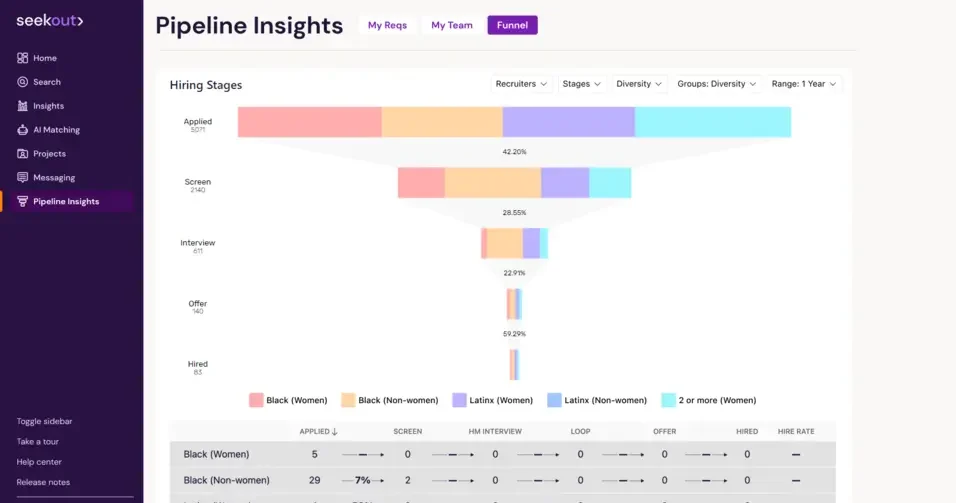
SeekOut pipeline insights.
SeekOut features
- Platform Foundation & Customization: SeekOut functions as a standalone sourcing and talent-intelligence layer rather than a full HR platform; Workspaces (introduced in 2026) connect search, scoring, and outreach into one configurable workflow built around a job description.
- Sourcing & Candidate Identification: This is SeekOut’s core strength — natural-language and Boolean-style search across a large candidate database, with 30+ filters, GitHub and patent data for technical talent, and dedicated diversity sourcing tools.
- Applicant Tracking & Candidate Management: Not a full ATS — SeekOut includes an inbound-applicant evaluation tool (Sam) but is typically paired with a separate ATS for full pipeline management.
- Recruiting Workflow: AI-driven outreach campaigns and an MCP integration layer support candidate engagement, though interview scheduling and offer management aren’t core features.
- Reporting & Analytics: Talent insights and market-trend data inform sourcing strategy and workforce planning, not hiring-funnel reporting.
How SeekOut pricing works
SeekOut’s plans are sold as annual or monthly, seat-based contracts with a minimum seat count, though a self-serve entry-level plan is available. They also offer a 14-day free trial.
- Recruit Core: Starting at $179/month
- Recruit – Sourcing: Custom Pricing
- Recruit – Sourcing + Integration: Custom pricing
- Recruit – Full Recruiting Funnel: Custom pricing
What markets does SeekOut serve?
SeekOut serves large enterprises and specialized HR or talent acquisition teams in technology, healthcare, biotech, and other fields where sourcing hard-to-find or highly technical talent is a priority.
Manatal – Best Affordable Recruiting Software
Manatal is a cloud-based recruitment platform aimed at HR teams and recruitment agencies that want AI-assisted hiring tools without enterprise-level pricing. The platform includes candidate tracking, a recruitment CRM, customizable Kanban-style pipelines, and a browser extension for sourcing candidates directly from LinkedIn and other sites. Manatal’s newer AI tools include candidate scoring and matching, multilingual resume parsing, candidate data enrichment, AI-generated job descriptions, an AI interviewer and notetaker, and access to connect recruitment data to outside AI tools.
- One of the most affordable full-featured ATS platforms on the market
- AI-powered candidate scoring and multilingual resume parsing included on lower tiers
- Simple, intuitive interface that’s quick to set up
- Reporting tools are less comprehensive than some higher-priced competitors
- Platform is still maturing relative to longer-established enterprise ATS providers
- Some advanced features require additional setup despite the overall simple interface
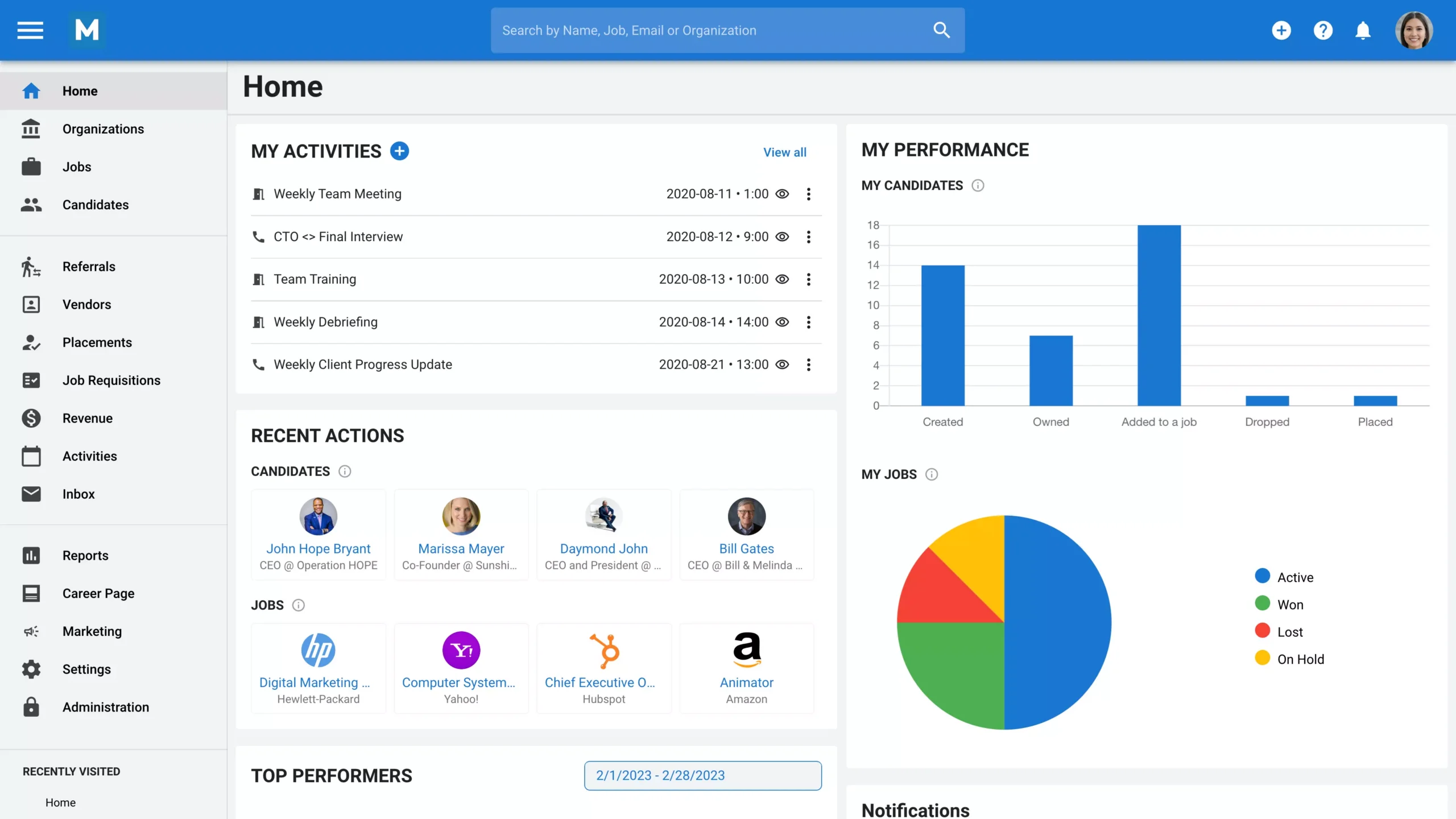
Manatal dashboard.
Manatal features
- Platform Foundation & Customization: Customizable Kanban pipelines and database fields, a complete API, and built-in GDPR, CCPA, and PDPA compliance tools.
- Sourcing & Candidate Identification: A Chrome sourcing extension plus sourcing from 2,500+ job boards, career pages, referrals, and LinkedIn.
- Applicant Tracking & Candidate Management: AI-powered candidate scoring and matching, multilingual resume parsing, and candidate data enrichment support pipeline management.
- Recruiting Workflow: An AI interviewer and notetaker, plus a recruitment CRM for client and lead tracking, support interview and follow-up stages.
- Reporting & Analytics: Custom reports and an analytics suite are available, though users describe reporting depth as less comprehensive than some higher-priced competitors.
How Manatal pricing works
Manatal offers per-user monthly pricing across several tiers, with lower rates on annual billing, plus a 14-day free trial.
- Professional: Starting at $19/user/month
- Enterprise: Starting at $39/user/month
- Enterprise Plus: Starting at $59/user/month
- Custom: Custom pricing
What markets does Manatal serve?
Manatal serves freelance recruiters, startups, SMBs, and mid-market and enterprise HR teams and staffing agencies that want an affordable, AI-assisted ATS without a large upfront commitment.

Recruit CRM – Best for Recruiting & Staffing Agencies
Recruit CRM combines an applicant tracking system with a recruiting CRM in a single platform, which makes it a strong fit for staffing and recruitment agencies that need to manage candidates, clients, and placements together. The platform includes resume parsing, Boolean search, job board posting, and radius search for location-based candidate and client searches. As a white-label solution, agencies can customize their careers pages, hiring and sales pipelines, database fields, and application forms, and add their own branding to client-facing documents like invoices.
- Combines candidate and client management in one system, useful for agencies
- Clean, fast interface with color-coded, drag-and-drop pipelines
- Wide range of integrations, including LinkedIn, Gmail, Outlook, Slack, and Zapier
- Pricing is higher than many ATS-only competitors aimed at in-house teams
- AI features and Boolean LinkedIn search are gated behind higher-tier plans
- Less suited to companies hiring only for their own internal roles rather than for clients
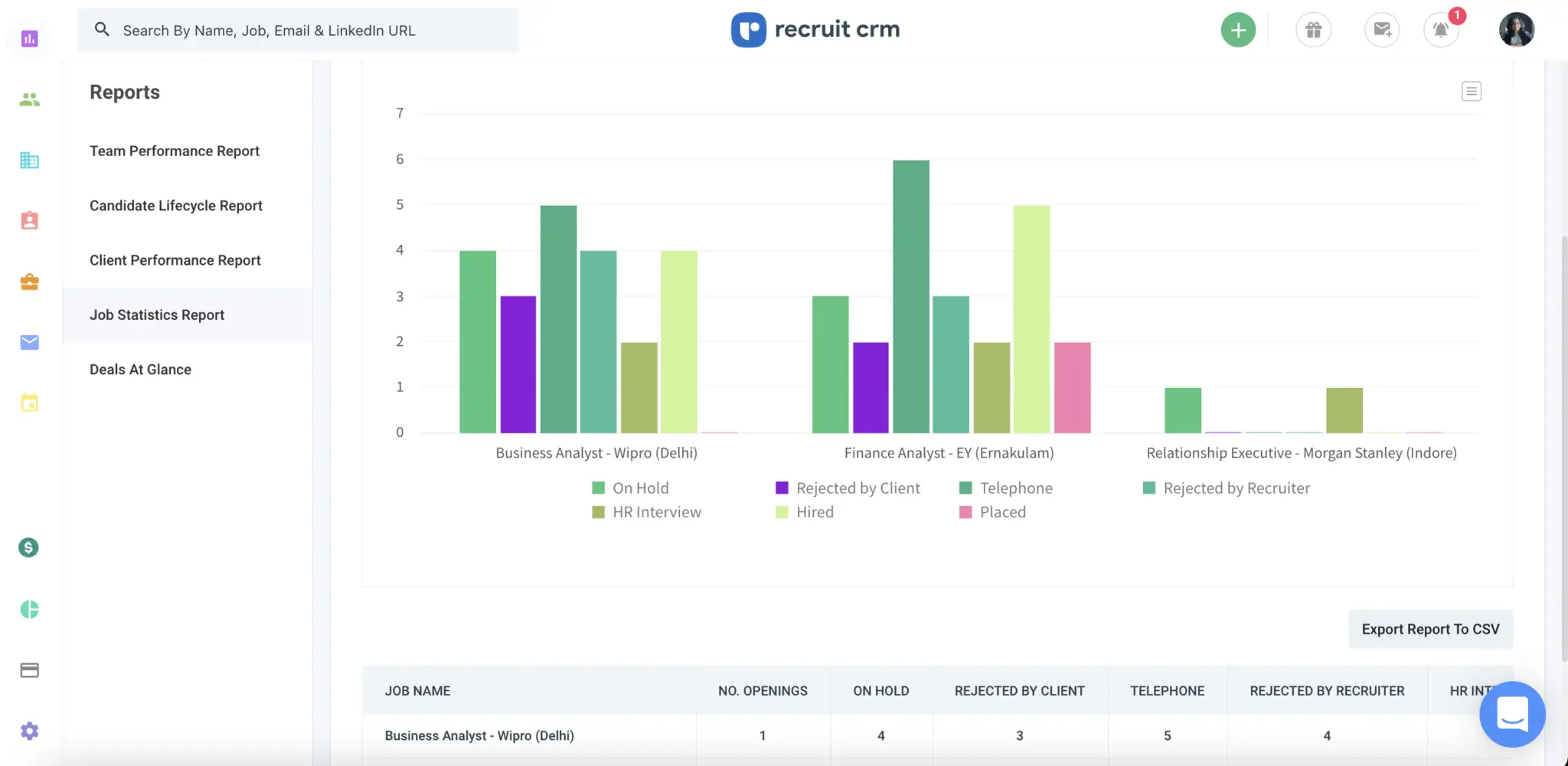
Recruit CRM job stats report.
Recruit CRM features
- Platform Foundation & Customization: White-label branding, customizable careers pages, hiring and sales pipelines, and database fields, plus an open API for connecting to other tools.
- Sourcing & Candidate Identification: Boolean and radius search, along with social sourcing, help agencies find candidates and clients by location or field.
- Applicant Tracking & Candidate Management: A combined ATS and CRM tracks candidates, clients, and placements together, with resume parsing and AI-powered candidate matching.
- Recruiting Workflow: Drag-and-drop pipelines, email sequencing, and interview coordination, plus invoicing and placement tracking to close out agency deals.
- Reporting & Analytics: Real-time reporting is included on all tiers, though AI features and Boolean LinkedIn Recruiter search are reserved for Business and Enterprise plans.
How Recruit CRM pricing works
Recruit CRM publishes its pricing tiers with lower rates for annual billing than monthly billing, and a 30-day free trial.
- Pro: Starting at $109/user/month
- Business: Starting at $159/user/month
- Enterprise: Starting at $259/user/month
What markets does Recruit CRM serve?
Recruit CRM is built for recruitment and staffing agencies, headhunters, and executive search firms that manage relationships with both candidates and paying clients, and is used by agencies in more than 75 countries.
Compare the Best Recruiting Software Side-by-Side
| Software name | Why we picked it | Starting price for cheapest plan | Highlights |
|---|---|---|---|
| RemotePeople | Best for Global Hiring | 2% of annual salary (spread over 12 months) | In-house recruitment bundled with EOR, payroll, and compliance in 150+ countries |
| Workable | Best for Small and Mid-Sized Teams | $360/month | Full-lifecycle ATS with strong screening and AI sourcing tools |
| SeekOut | Best for AI-Powered Candidate Sourcing | $179/month | Deep technical and diversity sourcing with GitHub and talent intelligence data |
| Manatal | Best Affordable Recruiting Software | $19/user/month | Budget-friendly ATS with AI candidate scoring and multilingual parsing |
| Recruit CRM | Best for Recruiting & Staffing Agencies | $109/user/month | Combined ATS and CRM built for agency candidate and client management |
What Is Recruiting Software?
Recruiting software is a digital platform that helps businesses manage the hiring process, from posting job openings and sourcing candidates to tracking applicants and scheduling interviews. Companies use recruiting software to organize candidate pipelines, automate repetitive administrative tasks, collaborate across hiring teams, and report on hiring metrics. The main difference between recruiting software and general project management tools is that recruiting software is purpose-built for the hiring workflow, including resume parsing, interview scorecards, and employment-specific compliance tracking.
What Are the Best Recruitment Software Tools?
The best recruitment software tools depend on your hiring needs, but leading options include Workable, SeekOut, Recruit CRM, Manatal, and RemotePeople. Workable is a strong choice for small and midsize hiring teams, while SeekOut suits advanced candidate sourcing. Recruit CRM is designed for staffing agencies, Manatal offers an affordable ATS, and RemotePeople combines recruitment with global hiring and employment services.
What Features Should I Look For in the Best Recruiting Software?
The best recruiting software should include applicant tracking, candidate sourcing, recruiting workflow tools, reporting and analytics, and customization options. Look for features such as a recruitment management system, job-board posting, resume parsing, AI-powered candidate matching, interview scheduling, video interviewing, background checks, recruitment marketing, automated communications, customizable hiring workflows, and detailed recruiting reports. Look for reporting tools that track metrics such as time-to-hire, cost per hire, and candidate conversion rates. Integration with other HR software and payroll systems can also make it easier to manage the hiring process from one platform.
What Are the Benefits of Using Recruiting Software?
Recruiting software offers companies an organized, efficient way to find, evaluate, and hire talent. Since candidate and client data lives in one system, hiring teams can reduce time lost to spreadsheets and scattered email threads, coordinate more easily across interviewers, and move candidates through the pipeline faster. Many platforms also use AI to screen resumes, score candidates, and surface passive talent, which can widen the candidate pool without adding recruiter headcount. For companies hiring internationally, recruiting software can also help manage compliance and employment requirements across different countries.
How Much Does Recruiting Software Cost?
Recruiting software costs depend on the vendor, the pricing model (per user, per employee, or per job), and the depth of features included. Generally, budget-friendly ATS platforms cost around $15 to $150 per user per month, while more advanced sourcing and talent intelligence platforms can run into the thousands of dollars per seat per year on annual, quote-based contracts. Agency-focused CRM platforms that combine candidate and client management typically start around $85 to $165 per user per month. Services like RemotePeople, which bundle recruitment with global employment and payroll, are usually priced per employee rather than per software seat.
Recruiting Software FAQs
What is an applicant tracking system (ATS)?
An applicant tracking system is recruiting software that manages job applications as they move through the hiring process, from application to offer. Companies use an ATS to organize candidate pipelines, track interview stages, and store resumes and candidate communication in one place.
What is the difference between an ATS and a recruiting CRM?
An ATS is focused on managing applicants for open roles, while a recruiting candidate relationship management (CRM) is built to nurture relationships with candidates and, for agencies, clients over time, even before a specific role opens. Many modern platforms, including several on this list, combine both functions in a single system.
Can recruiting software help with international hiring?
Yes, some recruiting platforms and services specialize in international hiring by combining recruitment with compliant employment infrastructure, such as localized contracts, international payroll, and work visa support. This is different from a typical ATS, which focuses on managing the hiring pipeline rather than the employment relationship itself.
How do AI features in recruiting software actually help recruiters?
AI features in recruiting software can screen resumes, score and rank candidates against job requirements, draft job descriptions and outreach messages, and surface passive candidates who match a role but haven’t applied. These tools are meant to reduce manual screening time, though recruiters still typically review AI recommendations before moving candidates forward.
How do I choose between an in-house ATS and an agency-focused platform?
If you’re hiring for your own company, an ATS-first platform built around a single hiring pipeline is usually a better fit. If you’re recruiting on behalf of multiple clients, a combined ATS and CRM platform designed for agencies will make it easier to manage candidate and client relationships in one place.
How We Chose the Best Recruiting Software
We selected the best recruiting software platforms through a standardized review of leading applicant tracking systems, sourcing platforms, and recruitment CRM tools. We evaluated each platform across four equally weighted categories.
- Features and Functionality: We assessed each recruiting software platform across five categories: platform foundation and customization, sourcing and candidate identification, applicant tracking and candidate management, recruiting workflow, and reporting and analytics. We considered the best recruiting software solutions to be those that provide tools to source, track, evaluate, and hire candidates efficiently. We also considered integrations, compliance features, and tools that connect recruiting to broader HR or CRM systems via APIs.
- Pricing and Fees: We compared each provider’s pricing plans, including monthly and annual subscription costs, per-user or per-employee pricing, and any extra charges for add-ons or premium features.
- Ease of Use and Support: We evaluated the setup process, dashboard usability, candidate pipeline management, automation, integration, and customer support each platform offers. Platforms with an intuitive interface, onboarding assistance, and responsive support performed better.
- Reliability and Reputation: The analysis factored in customer feedback, industry reputation, reliability, and user experience. Recruiting software platforms that delivered consistent performance and helped companies hire effectively ranked highly.